
Somewhere on Telegram right now, a channel with a shield in its logo is marking someone as a scammer. Maybe the verdict is right and it will save a dozen people their money. Maybe it is wrong and an honest seller just lost their reputation in front of thousands of subscribers, with no evidence shown and no way to respond. From the outside, both cases look identical: one line of text and a red cross.
That is the problem with Telegram scam lists. The idea is genuinely good. The execution decides whether it protects people or becomes a different kind of scam.
What a scam list is supposed to do
Deals on Telegram run on reputation because payments are mostly irreversible. Crypto, gift cards, Stars: once sent, gone. So communities build lists of known bad actors, and before dealing with a stranger, you check the list. When the list is honest, this works. One verified case warns thousands of future targets, and scammers have to burn their accounts and start over.
The value of the list is exactly equal to the quality of its verification. Which brings us to how most of these channels actually operate.
The rumor mill pattern
We documented a large scam list channel, 13,000 subscribers, that publishes verdicts in this exact format, quoted in full:
"User @name (id) has been marked as a scammer."
That is the entire post. In the twenty most recent posts on the channel's public feed when we captured it, every single accusation was published exactly like that. Each verdict links to a report page on the channel's website, so we followed the link on the one verdict we could actually fact-check, and here is why we could: it targets StarLedger, a bot listed in our own directory. We disclose that connection openly, and you should weigh our words knowing it. But it also means this is the rare verdict an outsider can audit end to end, and it does not survive the audit.
StarLedger is a working mini app for selling Telegram Stars. Its developer proved ownership to us with the bot's own token, and it holds a claimed Trustpilot profile rated 4.0 from 19 public reviews at the time the verdict was posted, most of them five-star, with real users confirming payouts arrive. Now the channel's complete case file for branding it a scammer, as published on their own report site: one complaint about a 6 dollar withdrawal said to be seven days late, marked handled the same day it was filed, with no response from the accused and no investigation shown. Their proof archive even includes the complainant's own balance screenshot reading Withdrawn 6.08 of 6.08 earned, which is the bot's records showing the payout as made. On that file, a business's reputation was spent in front of 13,000 subscribers.
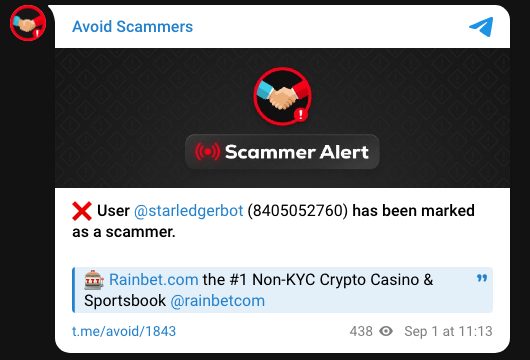
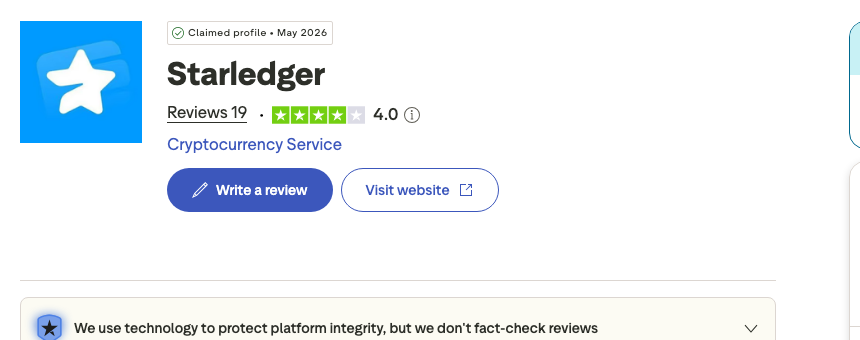
The one-line verdict with a casino ad under it, and the accused business's actual public review record.
We could check this one because we know it. Nobody can check the other nineteen, and that is exactly the problem. When the single verifiable verdict turns out baseless, every unverifiable verdict on the channel becomes a coin flip, and 13,000 people are treating those coin flips as facts.
Marking accounts without evidence does not just risk being wrong. It hands scammers a weapon: report your honest competitor to a rumor mill, and the mill does your dirty work for free. And when verdicts cost nothing to publish and carry no proof, a fair question hangs over every one of them: who decides, based on what, and what else can buy a verdict? We cannot answer that. Neither can the subscribers. That is the point.
The casino underneath
This is not a hidden connection you need to dig for. The channel's own bio states it word for word: "Sponsored by @rainbetcom - rainbet.com". Under every one of those verdicts, the same advertisement repeats, in the sponsor's own ad copy: "Rainbet.com the #1 Non-KYC Crypto Casino & Sportsbook," linked with the channel's referral code.
Sit with that combination for a second. The channel presents itself as protection against losing your money to strangers on the internet. Its revenue comes from referring its audience to no-KYC crypto gambling. A no-KYC casino means no identity checks, which also means no meaningful recourse when something goes wrong with your balance. The protector and the product point in opposite directions, and the same audience pays for both.
We are not saying every channel with ads is corrupt. Running a channel costs time and money. But there is a difference between an ad and a conflict of interest, and a scam-protection service earning referral income from gambling is the second one.
How to tell a real scam list from an accusation feed
| Ask this | Trustworthy list | Rumor mill |
|---|---|---|
| Is evidence published with each case? | Screenshots, payment proof, details | One-line verdicts, trust us |
| Can the accused respond? | A visible appeal process, wrong listings removed | No appeal path at all |
| Does renaming escape the list? | Cases track the permanent account id | Only the current @username |
| Who verifies? | A named process with a human decision | Whoever runs the channel, instantly |
| How is it funded? | Disclosed, unrelated to what it warns about | Referral links to gambling or "recovery services" |
The last row matters more than it looks. Channels that profit from gambling referrals need volume and engagement, and nothing drives engagement like a steady stream of dramatic verdicts. The incentive runs against careful verification.
What we do differently, and what we cannot do
Our scam list publishes nothing without evidence a human reviewer verified, tracks accounts by permanent id so renaming hides nothing, lists every channel, group, and bot a scammer runs, and gives every listed account an appeal path through the Is it Scam? bot. Reports are never anonymous to us, and reporter names are never shown to anyone.
Honesty about the limits, because a guide without limits is an advert: our list is young and small, and a clean check here is not a guarantee of safety, only the absence of a verified case. We cannot get stolen money back, and nobody legitimate can, which is why anyone offering paid "fund recovery" is running the follow-up scam. And human review means we publish slower than channels that publish instantly. We think slow and right beats fast and wrong when reputations are on the line.
What you can actually do about it
Reading about a problem changes nothing, so here is what does. If a channel like this has marked you or your business without evidence, report it from inside Telegram: open the channel, tap its name, tap Report, choose Scam. Forward example posts to @notoscam, Telegram's anti-scam team, or email abuse@telegram.org with links. Document your side publicly where your customers can see it, the way a Trustpilot profile documented StarLedger's. Every published case on our list has these action buttons built in, so acting takes one tap.
If you follow any scam list, apply the table above to it, including ours. A list that will not show you evidence does not deserve your trust, whoever runs it.
And if someone scammed you, report it where the report will be verified instead of weaponized: @IsScamRobot, with your screenshots and payment proof. Verified cases protect everyone. Unverified verdicts protect no one, and sometimes they are the attack.
Check before you deal
Thirty seconds of checking beats any amount of regret. Search the account on the scam list, or forward any message from the person to the bot and it reads the real account id, even when there is no username. If someone already scammed you, report it with your proof: press Report in the bot and follow the steps. Your evidence is what protects the next person.